
Vol. 5Scripture & Encouragement
You Need More Than
a Fresh Start
We can understand the truth, regret our sin, and promise to change while still needing the life only God can give. Jesus brings us to the source of that life and calls us to trust Him.
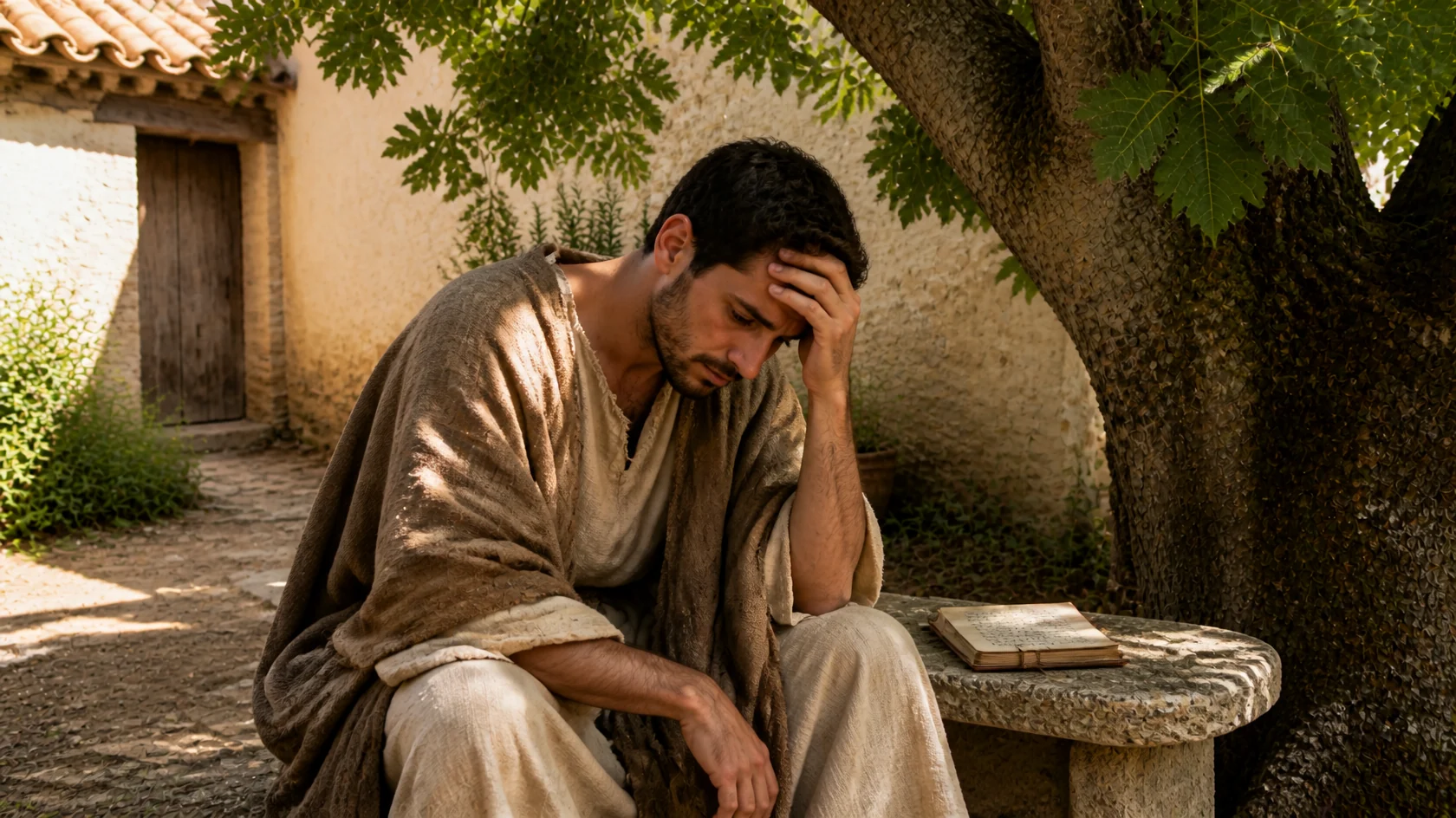
An artistic portrayal of Augustine’s garden; not a verified likeness or exact historical reconstruction.
12 minute read
“You must be born again.”
John 3:7 · NASB 1995 · Read John 3:1–8
Beneath a fig tree in a garden in Milan, Augustine wept over the hold that sin still had upon him. In his Confessions, he recalls an earlier prayer: “Grant me chastity and continency, but not yet.” He wanted God to change him, provided the change could wait. By the time he reached the garden, he could no longer hide his reluctance behind unanswered questions. He recognised the truth, yet recoiled from surrendering what he loved. His anguish exposed a divided heart, longing for freedom while still resisting the loss of its familiar chains.1
We may recognise something of ourselves in that struggle. We know the apology we need to make, the habit we need to confront, or the resentment we have kept alive long after the original wound. We promise that tomorrow we will deal with it. For a little while, the promise itself gives relief, allowing us to feel that change has begun before we have yielded anything. Then another opportunity passes, and we discover that knowing the right thing has not settled our willingness to do it. The trouble reaches deeper than a shortage of information.
A fresh start can be useful. A changed routine may help us keep a commitment, and firm boundaries can interrupt a destructive pattern. We should be grateful for practical help and willing to use it. Yet even a greatly improved life cannot erase our guilt before God or create the spiritual life we lack. We can rearrange our circumstances while carrying the same resistance to Him into each new beginning. Jesus addresses that deeper need in John 3, and He does so in a conversation with someone whose life appeared to be in remarkably good order.
Nicodemus was a Pharisee and a ruler of the Jews. He knew Israel’s Scriptures, held a respected position, and recognised that the signs Jesus performed testified to God’s presence with Him. When he came to Jesus by night, he approached as a teacher speaking to a teacher. Jesus answered him with words that reached beneath his standing and learning: “unless one is born again he cannot see the kingdom of God” (John 3:3). The kingdom required a life Nicodemus could not obtain through religious achievement. Even this teacher needed God to do something within him that his knowledge could never accomplish.2
That should make us careful about the confidence we place in religious familiarity. We may know how to explain the gospel while keeping our own need for mercy at a distance. We may defend biblical truth with conviction and still resent its authority over a private part of our lives. Knowledge matters because God makes Himself known through His Word. But the purpose of that knowledge is to bring us before Him in faith. Nicodemus’s understanding could not substitute for the new birth, any more than our ability to discuss salvation can substitute for trusting the Saviour.
Nicodemus struggled to understand. How could an old man enter his mother’s womb and be born a second time? His question reached for a physical explanation, while Jesus was speaking about life that comes from above. Birth is a searching image because it exposes our dependence. We received our first life; we did not create ourselves. Spiritual life likewise has its source beyond us. Jesus presses the necessity upon Nicodemus in verse 7: “You must be born again.” He is describing what every person needs to enter God’s kingdom, however respectable that person may appear.
When Jesus speaks of being born of water and the Spirit in verse 5, Ezekiel’s promise of cleansing and renewal helps us understand His words. God had spoken to a defiled people about cleansing them from their idols, giving them a new heart, and placing His Spirit within them so that they would walk in His ways (Ezekiel 36:25–27). This background also helps explain Jesus’ surprise that Israel’s teacher does not understand. The Scriptures Nicodemus taught had already announced God’s answer to the uncleanness and stubbornness of the human heart.3
Consider the mercy contained in that promise. God undertakes to cleanse people who cannot remove their own guilt and to renew hearts hardened against Him. He knows what His holiness requires, and He knows how deeply we need His intervention. His grace reaches the desires beneath our conduct, where outward reform cannot go. A person may learn to conceal anger while continuing to cherish it, or practise generosity while remaining hungry for praise. God’s renewing work brings us to acknowledge such motives and begins to form a willingness to obey Him because we belong to Him.
Jesus explains the necessity of this work in verse 6. Human birth gives us human life; the Holy Spirit gives spiritual life. Our natural resources cannot produce the life of God within us. Education can sharpen the mind, and discipline can strengthen a habit, but neither can make a fallen heart its own deliverer. The will itself is involved in our bondage. We can desire forgiveness because guilt is painful while still defending the sin we want forgiven. We need grace that reaches our resistance and brings us willingly to the Saviour we have resisted.
Scripture calls this life-giving work regeneration. God makes the sinner alive, and the sinner comes to Christ in repentance and faith. Our turning to Christ is real: we believe, we confess, and we receive Him. The power that brings us to life belongs to God. John holds these truths together when he describes those who receive Christ and believe in His name as people born of God (John 1:12–13). His grace does not make our response unnecessary; it brings us to respond willingly. We have no ground for boasting over someone who still needs the same mercy.2
Jesus then directs Nicodemus to the wind. Its sound can be heard, though its course lies beyond our command, and He uses this comparison to describe everyone born of the Spirit (John 3:8). The new birth cannot be scheduled, inherited, or manufactured by the force of a religious appeal. The Holy Spirit acts with divine freedom and power. This humbles everyone who teaches the gospel, including the parent who longs for a child to believe. We can explain the truth with care and urgency, but we cannot confer the life of which we speak.
Our dependence upon the Spirit gives us reason to pray and to keep opening the Scriptures. God brings people to new life through His Word (James 1:18; 1 Peter 1:23–25). We therefore speak the gospel, answer questions patiently, and ask Him to give understanding and faith. We need neither manipulate an emotional response nor retreat into silence because we cannot control the outcome. The Lord has entrusted His truth to ordinary people, and His power is sufficient to accomplish what their persuasion alone cannot do. That gives hope to faithful witness whose fruit we have yet to see.
The conversation with Nicodemus also shows us where that witness must lead. Jesus speaks of the Son of Man being lifted up, drawing upon Moses’ lifting up of the serpent in the wilderness, and promises eternal life to those who believe in Him (John 3:14–15). His words lead us toward the cross. The One who tells us that we need new life is the One who came to secure our salvation. He entered our humanity, lived in obedience to the Father, and bore the judgment our sins deserved. His resurrection confirms the victory in which every believer shares.
This is where a troubled conscience must find its rest. God’s work within us is real, but our acceptance before Him rests upon the righteousness of Christ. In regeneration He gives us life; in justification He declares us righteous through faith in His Son. These blessings belong together, and each directs our gratitude to Him. We are not required to produce enough improvement to make Christ’s sacrifice sufficient. His saving work is complete. The believer’s growing obedience follows from that mercy and must never become the price we imagine we must pay to remain welcome before God.4
If you are wondering whether you may come to Christ, His promise answers you. He receives the one who comes to Him (John 6:37). You do not need to discover the hidden moment of your new birth before trusting Him, or achieve a certain measure of sorrow before asking for mercy. Come honestly, with the sin you have excused and the guilt you cannot undo. Turn from the attempt to justify yourself and entrust yourself to the crucified and risen Lord. He is sufficient to save you, and His invitation gives you no reason to keep postponing that trust.
Nor must your experience resemble someone else’s conversion story. Some believers remember an unmistakable crisis; others came to faith through years of hearing Scripture and cannot identify the hour when understanding became personal trust. Tears can accompany repentance, but their intensity cannot establish the presence of new life. The question is whether we are resting in Christ now. A vivid memory can become a hiding place if we use it to dismiss His Word today. Equally, the absence of a dramatic memory should not unsettle the person who is presently looking to Him for salvation.4
For the Christian who continues to struggle, the necessity of new birth must be understood alongside the reality of growth. Spiritual life begins a conflict with sin; it does not immediately remove every sinful desire. Paul describes the opposition between the flesh and the Spirit, and John directs believers who sin to Christ their Advocate (Galatians 5:16–17; 1 John 2:1–2). Failure must be confessed, but it need not drive a believer away from the Saviour. The One who received you knows the weakness you are now bringing before Him, and His mercy remains the ground of your approach.
The Spirit’s work becomes visible as our relationship to sin changes. A person accustomed to defending every angry outburst begins to acknowledge the harm without blaming everyone else. An apology becomes an honest request for forgiveness, accompanied by a willingness to change and to allow trust time to grow again. Such obedience may develop slowly, through difficult confession and patient help from others. It matters because God forms holiness in those He renews. Yet the evidence of His work must always direct us back to gratitude for Christ, rather than become a new way of measuring whether we have earned His love.
There is also a warning here for the person who wants religious reassurance while deliberately protecting a settled rebellion. We cannot appeal to grace as permission to refuse the Lord who gives it. If we intend to keep a dishonest practice, nourish hatred, or hide an indulgence from every searching question, familiar Christian language will not make that refusal safe. Jesus brings our need into the light so that we may come to Him truthfully. The sin we are afraid to surrender is already known to Him, and continuing to conceal it only prolongs our bondage.
For those who belong to Christ, returning after failure means confession and renewed obedience. The new birth does not need to be repeated whenever we stumble. God calls us to live from the life He has given, depending upon His Spirit as we face what must change. That may require asking someone we have hurt to forgive us, ending access to a temptation, or inviting a mature believer to help us act upon what we already know. These steps are the practice of repentance within a life sustained by grace. We take them because Christ has become our hope.
As you read John 3 this week, give particular attention to the place where knowledge has become a way of postponing obedience. Ask God to expose whatever you have kept outside the reach of His Word. Perhaps you have spent years preparing to become serious about Him, or perhaps you are a believer who has grown tired of confronting the same sin. Be honest about your need, and bring it to Christ. Open the Scriptures with a willingness to be addressed by them, and seek help where obedience has remained only an intention.
In the garden, Augustine recounts hearing a child’s voice repeat, “Take up and read.” He returned to where Alypius was sitting and opened Paul’s writings. Romans 13:13–14 confronted sinful indulgence and directed him to the Lord Jesus Christ. He describes an assurance that dispelled his doubts. The encounter leads our attention to the Saviour made known in Scripture, whose mercy reached him amid the struggle he could no longer resolve for himself.1
You may have promised yourself a different life so often that another promise now feels empty. Jesus tells the truth about the depth of your need, and He brings you to the God who can meet it. The new life you need comes from His Spirit; the forgiveness you need rests upon His finished work. Come to Him with the whole truth about yourself. Receive His mercy, and learn to walk in the obedience His grace produces. Your hope can rest in a faithful Saviour whose sufficiency reaches beyond the failure of your resolutions and whose care extends through the life He gives.
Prayer
Father, You know the things we promise to surrender and the excuses by which we keep them. Forgive our pride and our confidence in our own ability to make ourselves right with You. By Your Spirit, bring those who do not know Christ to life and faith in Him. For those who belong to Him, deepen repentance and restore the joy of trusting His finished work. Give us courage to confess what we have hidden and to obey what we already understand. Keep us close to Your Word, grateful for Your mercy, and willing to receive the help You provide through Your people. In Jesus’ name, amen.
For reflection
- Read John 3:1–8. Where are you tempted to rely on religious knowledge, outward respectability, or a promise to improve instead of trusting Christ? What does Jesus say your deepest need is?
- Read Ezekiel 36:25–27 and John 3:14–18. What does God promise to do within His people, and what has Christ done to secure their salvation? How do these truths bring both humility and hope?
- What act of repentance have you been postponing? Name one step you can take in dependence upon Christ, and identify a faithful person who can help you follow through.
Further study
Birth and belief. Read John 1:12–13; 3:1–21; and 6:35–40. Distinguish the divine source of spiritual life from the real human response of receiving Christ. Notice how Jesus joins the necessity of grace with an open invitation to come to Him.
Cleansing and the promised Spirit. Read Ezekiel 36:22–32 and Titus 3:3–7. Attend to Ezekiel’s setting among a defiled people whom God promises to restore for His name’s sake. Trace the connection between cleansing, inward renewal, and obedience without making obedience the cause of saving mercy.
Grace and continuing growth. Read Ephesians 2:1–10; Philippians 2:12–13; and Galatians 5:16–25. Consider why God’s initiative establishes our dependence and our responsibility to obey. Ask how the fruit of His work can encourage faith while Christ Himself remains the ground of our acceptance.
Sources and study notes
- Augustine in the garden. Augustine, Confessions VIII.7.17, VIII.8.19, and VIII.12.28–29; translated by J. G. Pilkington, in Nicene and Post Nicene Fathers, First Series, volume 1, edited by Philip Schaff, 1887; New Advent edition. The historical opening and return to the garden follow Augustine’s retrospective account. His earlier prayer and the words he reports hearing are quoted from this translation. No unrecorded dialogue or sensory detail is supplied. Online text checked October 31, 2026. Augustine, Confessions, Book VIII.
- John on the source of spiritual life. Capt. Solomon D. Crowe, Born of God, supplied manuscript, chapter 7, especially the opening exposition and sections on Nicodemus, the necessity of new birth, and the sovereign Spirit; PDF pages 99–112. See also No One Can Come Unless Drawn, abstract and introduction. These sources inform the distinction between God’s life-giving work and the sinner’s real response of repentance and faith. The article is newly written, not an excerpt from either manuscript. John 3:1–21 was checked in the NASB 1995. John 3 in the NASB 1995.
- Water and the Spirit. The reading adopted here understands John 3:5 against Ezekiel 36:25–27, with John 3:10 providing contextual support. This is an interpretive judgment, not an explicit quotation of Ezekiel by Jesus. Christian traditions differ concerning the verse’s relation to baptism. The article affirms the necessity of God’s cleansing and renewal without treating baptism as contemptible or an outward act as a means of controlling the Spirit. John Calvin, Commentary on the Gospel According to John, volume 1, translated by William Pringle, comments on John 3:5–6, was also consulted for his treatment of inward purification and the Spirit as the source of new life. No direct Calvin quotation is used; his treatment of the language in 3:3 is not adopted wholesale. Ezekiel 36:25–27. Calvin’s Commentary on John, Volume 1.
- Assurance and the life that follows. Capt. Solomon D. Crowe, Sure in Christ, supplied 6 by 9 print interior, chapter Born from Above, printed pages 75–84, especially pages 78–79 and 82–83. Consulted for the distinction between regeneration, conversion, justification, and growth in holiness; quiet conversions; the limits of remembered decisions; and the danger of requiring proof of regeneration before coming to Christ. The paragraph about anger is an original pastoral illustration, not a reported incident. Its details carry no claim about the author’s personal history.
Scripture quotations marked NASB 1995 are from the New American Standard Bible®, Copyright © 1960, 1971, 1977, 1995 by The Lockman Foundation. All rights reserved.
Scripture & Encouragement
A devotional for your week.
Receive Through the Fire devotionals by email, with Scripture, a prayer, and questions to carry into the week.
Sign up for the weekly devotional